Beggars Bush: A Perambulation through the Disciplines of History, Geography, Archaeology, Literature, Philology, Natural History, Botany, Biography & Beggary
This site has been around for more than 10 years so it is a bit clunky. There is a gazetteer of places and an index of literary examples, which link to detailed records.
Under Tags ‘The Play’ has posts about the play by John Fletcher and Philip Massinger, and the history of performances, with offshoots of that published by the rogue Francis Kirkman, and the afterlife of Clause, King of the Beggars.
The Tag ‘Speculations’ has explorations of the way the phrase was distributed, explanations, dead ends and other related information, like why the OED is wrong.
This isn’t a linear narrative, as this attempt to map the project shows. There is more about how to use the site here. If you are looking for something specific use Search. But you are welcome to just follow where it takes you; that’s what I did.
And if you know more, or better, or just want to say something please do. I hope you find something of interest.
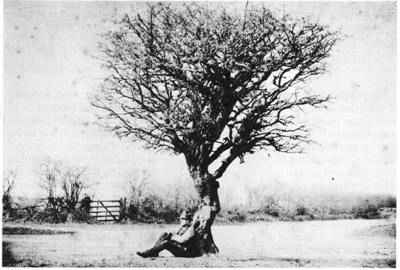
A beggar under the Beggars Bush at Oscott – possibly . . .
John Ogilby, the royal cosmographer, in 1675 produced Britannia an atlas, celebrated in the history of cartography. The pre-turnpike road network was not depicted with any accuracy until Ogilby published his atlas of “principal roads” of England and Wales in 1675. Britannia consisted of strip maps at 1:63360 scale of 85 routes on 100 copper plates which surveyed and mapped over 7500 miles of road.
In the play ‘The Beggars Bush’ the election of Clause as the King of the Beggars in Act II Scene 1 is celebrated with a song sung by “orator” Higgen. The song was reproduced as a seperate text in many collections of songs. It is generally ascribed to John Fletcher. Much of the beggars material in ‘The Beggars Bush’ was taken from the rogue literature of the late sixteenth and early seventeeth century. However, the source for the song is a much earlier and more respectable text – The Colloquies’ of Desiderius Erasmus, the “Prince of Christian Humanists”
My thanks are due to Philip Saunders for many things in my researches into Beggars Bush.
His article Beggar’s Bush to King’s Bush, Records of Huntingdonshire, Vol.3 No.2, (1993) p.13-15, first alerted me to the role of Saxton’s Five Counties Map. He then helped as Principal Archivist at Cambridgeshire Archives and Local Studies Service. I am now grateful to him for resurrecting Records of Huntingdonshire, Journal of the Huntingdonshire Local History Society, and for publishing my article Beggar’s Bush Revisited in Vol.4 No.3 p.32-37. This updates his original article with some of the material from this website on maps, anthologies and John Taylor.
Philip Saunders has also found another map of Beggars Bush for the cover – William Kip’s 1607 version of Saxton’s map, which transforms Saxton’s single tree to a whole forest around Beggesbush. This is likely to be artistic licence rather than any resurvey.
Neil Howlett, Beggar’s Bush Revisited in Vol.4 No.3 (2014) p.32-37
Copies are available from Philip Saunders, 21 Crowlands, Cottenham, Cambridge CB24 8TE
When I was at school it was one of my ambitions (along with playing full-back for England and bass with Miles Davis or the Allman Brothers Band) to know more about something than single subject than anyone else in the world. My other ambitions not having been achieved I may now know more about Beggars Bush than any other living person, though I don’t think it makes me a better person.
However, I do feel a sense of achievement in having an refereed article published in the journal of the Society for Name Studies in Britain and Ireland. That can now be cited as Howlett, N, ‘The place-name Beggars Bush‘, Nomina, 34 (2011) p.133.
I would like to thanks the editor, Maggie Scott, and the anonymous referee for their help in putting into coherent simple form my findings about the use of the place-name and its meaning. I have tried to acknowledge in the article and on this website the many other people who have helped me over the many years I have wrestled with this subject. Thank you again all of you.
For new readers please see About and How to Use this website. Please contribute and correct where your knowledge is greater than mine.
For those readers not members of the Society for Name Studies in Britain and Ireland you can join www.snsbi.org.uk .
I am also awaiting publication of an article in The Annals of Huntingdonshire which concentrates on the place-name at Godminster, and the influence of Christopher Saxton’s maps in the distribution of the name.
W.C. Hazlitt, English Proverbs and Proverbial Phrases (London, 1869, p.82) gives:
Beggar’s bush, Briton’s row: Fox Fold, Garton Ho.
G. L. Apperson, English Proverbs and Proverbial Phrases: A Historical Dictionary (London, 1929, p.89) gives a variant Fox Row.
This seems to record a colloquial derogatory reference to a Briton’s Row in Gorton, Manchester, which would fit the derogatory use. However, it appears to be an error. Read the rest of this entry »
“Beggar’s Bush is no place for a woman, much less a lady.”
“Old Badmin is a decently dressed rogue, and does the devil’s work in our village so cleverly, it takes two honest men to lay hold of him in the act and deed of villainy. Card sharper, poacher, retailer of rum and gin without a licence, and many a sober man’s sober son has he ruined and sent across seas, having picked his bones and used him for a cat’s paw. All last winter his small farm, Beggar’s Bush, was a rendezvous for the scum of the parish, to-night is this, year’s inauguration ; a first and last carousel.”
“Amongst those turf bogs no man of your father’s weight could find a footing. They skirt Beggar’s Bush ; there, yonder, is the farm, more than one path leads from it to St. Cuthbert’s. None but fools or madmen would try the moors to-night, even with an experienced guide. A slip into these treacherous dykes, and the strongest traveller fares the worst; his frantic, efforts do but engulf him the more surely.”
“Beggar’s Bush deserted, got a tenant after some time, a quiet, sober man, seemingly intent upon digging and drying, and re-claiming the land by a system of drainage. The farm was his own, he said, and had been let to a very bad tenant by his agents, determining him to see after the property himself.”
I hesitate to include this tedious execrable novel in the list of literary references – I do so for completeness, not as an encouragement to read it.
The usage of Beggars Bush is characteristic of the imagination expended by the author. As well as a bad man called Badmin, the book includes Constable Duffer and a villain called Marmaduke Chatterson. He, inexplicably, is also the husband of the heroine’s nursemaid Prudence, before his supposed death on the Lusitania, reappearance, further disappearance mysteriously connected with the heroine’s father drowning in a bog and deathbed repentance in a workhouse. Read the rest of this entry »
The Nigard stoppes, for he, his prayers, deceaves,
Your Liberall Charrity from open Palmes
Makes us this confident to Aske your Almes
The Beggers have their Motives: Soe have wee
They crye their loss of Limbes, Age, Insanitiee
Theise our Infant days w’yee, yet: our Playes
(Though wee act none but such as got the Bayes)
Are Old: our habites too are meane: the same
Our action maimed, decrepit, feeble, Lame,
All movers of compassion: Let that fall
(as usuill) & your Charity mends all
For as A generall Rule wee ever make it
Not what? Or how we Act? But how you take it.
This prologue to Fletcher & Massinger’s playThe Beggars Bush (1622) survives in one manuscript copy in the notebook of John Clavell, with notes, copy letters, epigrams and remedies. They were probably written by Clavell in 1637 when he was in Ireland. Read the rest of this entry »