Beggars Bush: A Perambulation through the Disciplines of History, Geography, Archaeology, Literature, Philology, Natural History, Botany, Biography & Beggary
This site has been around for more than 10 years so it is a bit clunky. There is a gazetteer of places and an index of literary examples, which link to detailed records.
Under Tags ‘The Play’ has posts about the play by John Fletcher and Philip Massinger, and the history of performances, with offshoots of that published by the rogue Francis Kirkman, and the afterlife of Clause, King of the Beggars.
The Tag ‘Speculations’ has explorations of the way the phrase was distributed, explanations, dead ends and other related information, like why the OED is wrong.
This isn’t a linear narrative, as this attempt to map the project shows. There is more about how to use the site here. If you are looking for something specific use Search. But you are welcome to just follow where it takes you; that’s what I did.
And if you know more, or better, or just want to say something please do. I hope you find something of interest.
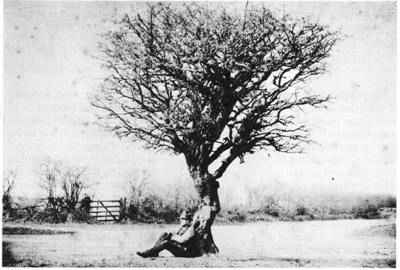
A beggar under the Beggars Bush at Oscott – possibly . . .
This shows the frequency with which the Beggars Bush appears as a phrase in printed works which have survived and been digitised. The early spike includes Anger, Porter, and Marprelate, but the lull afterwards shows the absence of the phrase from the coney-catching pamphlets which followed. I think the small spike from c.1620 and the big spike and continued higher figures after 1660 are largely the result of the performance and then publication of the play when the theatres re-opened. With the sudden drop around 1690 arising from the Glorious Revolution and the arrival of King William of Orange. The database ends at 1700.
This is courtesy of the The EarlyPrint Lab which offers a range of tools for the computational exploration and analysis of English print culture before 1700. They say they apply these tools to a corpus of more than 60,000 early English printed documents, roughly 1.65 billion words. They intend the Lab as a provocation, not a finished toolkit. By exposing the corpus of early printed texts at scale we hope to defamiliarize familiar texts and invite exploration of unfamiliar ones. The tools and visualizations offer perspectives on the corpus that invite users to probe early English discursive history in ways that complement the search capabilities of EEBO-TCP and the Oxford English Dictionary (and LEME – the brilliant but sadly no longer available Lexicons of Early Modern English.
5. Gaming, Is the High-Way to Beggars-Bush; a bewitching vanity, that will not suffer a man to keep his money in his pocket, without putting it to the hazard of a Throw, whether it shall continue his own or be anothers,
Such is the advice given by the anonymous author of the single sheet pamphlet ‘The Art of Thriving or, the way to Get and Keep Money: Being, a Seasonable Caution to Slothful Drones and Prodigal Spend-thrifts: Containing sundry Excellent Rules and Observations for Promoting Good-husbandry, and Banishing Idleness and Profuseness, the certain Parents of Poverty: Principally intended for an Admonition to Youth, but necessary to be practiced by all persons in these hard Times; and to be set up in every Family.’ London: Printed for J. Coniers, and are to be sold at the entrance into Popes-head Alley, next Lombard-street, 1674.
Other causes were to be gaudy in apparel, a Liqourish Touch or Extravagant Diet, Drinking (or as they name it) Good Fellowship, Courting of women and after Gaming, Suretyship and trusting to servants. The pamphlet also includes a useful table of weekly, monthly and annual expenses or wages, encouraging long terms saving and anticipating Charles Dickens’s famous dichotomy of happiness and misery.
My thanks are due to Philip Saunders for many things in my researches into Beggars Bush.
His article Beggar’s Bush to King’s Bush, Records of Huntingdonshire, Vol.3 No.2, (1993) p.13-15, first alerted me to the role of Saxton’s Five Counties Map. He then helped as Principal Archivist at Cambridgeshire Archives and Local Studies Service. I am now grateful to him for resurrecting Records of Huntingdonshire, Journal of the Huntingdonshire Local History Society, and for publishing my article Beggar’s Bush Revisited in Vol.4 No.3 p.32-37. This updates his original article with some of the material from this website on maps, anthologies and John Taylor.
Philip Saunders has also found another map of Beggars Bush for the cover – William Kip’s 1607 version of Saxton’s map, which transforms Saxton’s single tree to a whole forest around Beggesbush. This is likely to be artistic licence rather than any resurvey.
Neil Howlett, Beggar’s Bush Revisited in Vol.4 No.3 (2014) p.32-37
Copies are available from Philip Saunders, 21 Crowlands, Cottenham, Cambridge CB24 8TE
When I was at school it was one of my ambitions (along with playing full-back for England and bass with Miles Davis or the Allman Brothers Band) to know more about something than single subject than anyone else in the world. My other ambitions not having been achieved I may now know more about Beggars Bush than any other living person, though I don’t think it makes me a better person.
However, I do feel a sense of achievement in having an refereed article published in the journal of the Society for Name Studies in Britain and Ireland. That can now be cited as Howlett, N, ‘The place-name Beggars Bush‘, Nomina, 34 (2011) p.133.
I would like to thanks the editor, Maggie Scott, and the anonymous referee for their help in putting into coherent simple form my findings about the use of the place-name and its meaning. I have tried to acknowledge in the article and on this website the many other people who have helped me over the many years I have wrestled with this subject. Thank you again all of you.
For new readers please see About and How to Use this website. Please contribute and correct where your knowledge is greater than mine.
For those readers not members of the Society for Name Studies in Britain and Ireland you can join www.snsbi.org.uk .
I am also awaiting publication of an article in The Annals of Huntingdonshire which concentrates on the place-name at Godminster, and the influence of Christopher Saxton’s maps in the distribution of the name.